
How to Stick to Long-Term Goals (Even When Motivation Drops)
Feb 22
·
Reading time: 11 minutes


Introduction
Open any social media feed or attend a business conference and someone will tell you that lifelong learning is the skill of the era. It appears in every future-of-work report, every leadership communication about AI transformation, every keynote about staying relevant. The message is clear: the pace of change means we can never stop learning, and if we do, we will become obsolete.
Fair enough. There is just one problem: when are we supposed to fit that into our already overpacked calendars? For me personally, between raising small humans, work, expat life with no family nearby to help out and no friends to recharge with, and maintaining a healthy lifestyle (because we need to be lifting weights and taking 10,000 steps a day too, remember?), there just isn’t enough time.
And I know I am not the only one feeling this way. According to Gallup's 2024 State of the Global Workplace report, employee wellbeing has declined since its peak in 2022, and 41% of employees globally reported experiencing a lot of stress the previous day. Eurofound’s 2024 e-survey points to worsening mental health and falling optimism/life satisfaction across the EU. People are not running a surplus of time, attention, and energy that lifelong learning can simply draw from.
In other words, lifelong learning seems to be added to our lives when many of us are already running close to capacity. This creates a problem for each of us individually, and for organizations investing in their employees' skills (which is exactly what a client came to me with when they asked me to help their employees stick to learning AI). The key question, then, is this: Is there a way to pursue long-term goals like lifelong learning that doesn’t require unlimited willpower or doesn’t end in failure?
That is what this article is about. I use lifelong learning as the example because it is the pressure most people are feeling right now, but the behavioral mechanisms underneath apply to any long-term goal that requires repeated effort: exercise, diet, a new language, saving for retirement.
The Problem with Relying on Motivation and Strong Will
Most of us have absorbed a simple story about long-term goals: if you keep going, you’re disciplined; if you fall off, something is wrong with you. It makes long-term change feel like a personality test.
The first problem is that intention alone isn’t always enough to start. A consistent finding in behavioral science is how poorly intentions predict behavior over time. Sheeran and Webb found that intentions account for approximately 28% of the variance in actual behavior. That leaves the rest explained by other factors: competing demands, habits, emotions, social influences, or the environment we’re in.
We can truly want to do something, and yet most of us won’t even start (let alone finish) because of other barriers. Since we’re talking about lifelong learning, let’s look at e-learning. Jordan’s analysis of 221 MOOCs found completion rates ranged from 0.7% to 52.1%, with a median of 12.6%.
Though by this point, I probably don't need to cite the research. We all know this from personal experience. Anyone who’s ever started a diet on Monday just to be eating pizza by Thursday, bought books they really wanted to read but never actually read them, or signed up for a spring half marathon and then ended up watching Netflix in the evenings and on weekends all winter long, knows what I’m talking about. We’re trying to achieve long-term goals with short-term psychological resources.
Motivation Declines, and Our Capacity Is Limited
Part of what makes long-term goal pursuit so difficult is that it relies on two resources, both of which fluctuate and get depleted faster than the long-term goal pursuit timeline.
- First, we need motivation. Motivation is desire or willingness: Does this feel worth doing right now?
- We also need capacity. Capacity is ability or bandwidth: Can I actually do it right now, given my cognitive load, stress, sleep, competing demands?
Together, motivation and capacity create readiness. Readiness answers the question: Am I both up for it and able to do it right now?
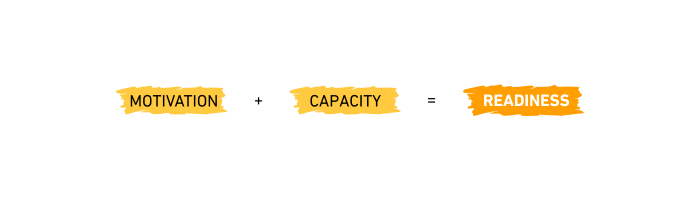
The problem is that motivation fluctuates, and capacity is a limited resource. Four forces usually push our readiness down over time:
All this makes willpower a poor strategy in lifelong learning, or any other long-term goal pursuit. Which raises the questions: What can we do about it? Are we doomed to start things with great intentions and abandon them by week three?
- Mental Load: Our capacity for mental effort (e.g., reading, analyzing, learning something new) draws from a limited pool. By the time most people sit down to learn, that pool has already taken a significant hit from the demands of the day.
- The Novelty Effect: At first, novelty can make the experience feel more rewarding. As outcomes become familiar and predictable, that “freshness” fades.
- Costs vs. Benefits: Once the initial excitement fades, we’re left in a situation where we need to exert effort to keep going while benefits are distant. The brain discounts distant rewards, so “skip today” starts to win.
- Self-Control: Under stress, sleep loss, and heavy decision load, self-control becomes less reliable. This reduces the likelihood you’ll choose the effortful option, especially when easier alternatives are right there.
All this makes willpower a poor strategy in lifelong learning, or any other long-term goal pursuit. Which raises the questions: What can we do about it? Are we doomed to start things with great intentions and abandon them by week three?
A More Realistic Way
There is a more realistic way: Design a system that carries you through the bad days, so you don't have to rely on motivation or willpower.
By “design a system” I mean anything and everything that will make the desired behavior easier, more fun, and the default way. It’s often the practical, unglamorous stuff:
- pre-committing,
- setting reminders,
- having an accountability buddy,
- monitoring progress,
- turning your goal pursuit into a friendly competition.
The exact tactics will depend on the behavior and the context. Learning AI at work looks different from training for learning a new language on your own. But the underlying logic is the same: remove the need for a decision every time, and make it easier to do even when you’re tired.
Sounds unglamorous, right? It is. But here is the thing: it works. Just look at some of the research:
- In a study summary by Matthews, participants who wrote goals, committed to specific actions, and sent weekly progress updates to a friend reported higher goal achievement than those who only held goals in mind (76% vs 43%).
- Having if-then plans, i.e., deciding in advance when, where, and how you will act, produced a medium-to-large effect on goal attainment across 94 studies and over 8,000 participants.
- A large meta-analysis of 138 studies found that monitoring and recording your progress increased the likelihood of reaching a goal — with the strongest effects when progress was physically recorded and reported to someone else.
Design Your System
Make It Easy and the Default Choice
- Set goals, but make them tiny. On the high motivation days, your brain will try to sell you an ambitious identity makeover. Ignore it. Start with a commitment that feels almost embarrassingly small (e.g., 10 minutes, twice a week, or one lesson every two days). Achieving a goal builds momentum and makes the next session easier to start. If you want to raise the bar later, you can always do so.
- Reduce friction like your life depends on it. Small frictions become big barriers. Look for friction in three places:
- Physical friction: Keep what you need visible and ready. Keep your laptop in the room. Put the book on your desk, not hidden away on a shelf.
- Digital friction: Bookmark the page. Keep the course tab open. Stay logged in. If you need to search for “where was that module again,” you’re already losing.
- Cognitive friction (the big one): Remove decisions. Pre-select the next lesson. Write down the next step at the end of every session: “Next time: Lesson 3, Section 2, do exercise X.” If have to decide what to do when you sit down to work, you're increasing the risk that your brain will decide to do nothing.
- Have if–then plans. Think of them as scripts for your future self, who will be less motivated. If you have to stop and figure out what to do in that moment, there’s a good chance you won’t do anything at all. If–then plans remove the need to negotiate with yourself when your bandwidth is low.
Make It Fun and Immediately Rewarding
- Make the payoff immediate. Your brain is not impressed by “this will help my career in 5-10 years.” It cares about what it gets this week. Tie learning to a current irritation at work: summarizing long documents, cleaning up slides, making sense of messy notes. Make whatever you’re doing make this Tuesday less painful, not next year.
- Make progress visible. Create “proof of improvement.” Track completed modules, keep a checklist, write one sentence after each session (“Today I learned X”), and save small before-and-after artifacts (e.g., a prompt that got better, a workflow that took five minutes less). Visible progress reduces the “is this even working?” feeling that makes people quit. It also feels rewarding.
- Make it enjoyable in a way that works for you. “Fun” can mean gamification but it can also mean calm, mastery, curiosity, or simply not hating the process. Choose a format you like: short videos, hands-on exercises, learning with a buddy, or while walking on a treadmill. If the process feels like punishment, you will eventually avoid it.
Don’t Do It Alone
- Buddy up. Pick one person and agree to collaborate on this together. Do weekly check-ins, a shared sprint, or send a message every Friday confirming you did your sessions.
- Turn it into a friendly competition. Competitions work because they create social accountability and a bit of positive pressure, which makes the effort feel more immediate and worth doing. Keep it fun and simple (e.g., who can apply one new AI use case this week or finish the next module first).
- Look for and create social proof. We’re more likely to do something if we know that people similar to us are already doing it. Make the desired behavior more public, if you can, for example by creating a team channel or a shared progress scoreboard.
Give It Structure And Deadlines
- Chunk it up. “Learn AI this year” is too abstract to feel actionable. If your brain can’t see a clear task with a finish line soon, it will procrastinate. Split your learning into shorter cycles, each with a clear start and end date. Deadlines increase focus and create a sense of accomplishment.
- Block time. Don’t rely on “I’ll do it when I have time.” Choose a specific window (e.g., Tue/Thu 9:00–9:15) and treat it like a standing appointment. When time is pre-decided, you remove the daily negotiation that usually ends with “later.”
- Outsource remembering. Remembering is cognitive effort. If your learning plan depends on you “keeping it in mind,” it will lose to whatever is urgent. Block the time. Add reminders. Stack the session onto an existing routine (after coffee, after lunch, after the school run).
One More Thing: You Will Fall Off, So Design for That Too
At some point, you will miss a week. This week's lessons will get derailed by a deadline, a sick kid, or a trip. This is a certainty for anyone pursuing a long-term goal while also living a life. And if you're anything like me, you'll blame yourself when it happens.
How you react matters. Research suggests that self-compassion after failure can increase self-improvement motivation and reduce the self-judgment that makes people avoid getting back on track.
Most importantly, plan that you'll fall off and will need help getting back on track. Build a restart into your system. Do it, even if your highly motivated, overly ambitious mind tells you today that you won't need it.
What this looks like will depend on your circumstances. It might be as simple as putting a 30-minute “restart” appointment in your calendar every six weeks. If you fall off, you already have a reminder and dedicated time waiting to help you restart. If you don’t, you get 30 minutes of your life back. Either way, it’s a win.
Structure > Willpower
There is a timing problem at the heart of all of this. We're expected to continuously learn at a moment when our readiness is already low because we’re overloaded, our attention is fractured, and we don't have the required cognitive resources.
In that context, “try harder” is ineffective advice, because it expects us to spend willpower and energy we don’t have. What helps is reducing the need for willpower: fewer decisions, lower friction, and a plan that still works on low-energy days. Motivation will fluctuate (it always does), but a system can keep the behavior alive when it does. So use your good days to build a system that will carry you through the bad ones.
You may also like...

How to Effectively Change Organizational Culture: A Behavioral Scientist's Approach
Oct 19
· Reading time: 12 minutes

Automating the Wrong Things: How We Are Destroying Meaningful Work (And Ourselves)
May 18
· Reading time: 11 minutes


Global warming is one of the toughest problems to solve if we consider how our irrational minds work. This is why I support World Land Trust, a foundation that does great things to protect ecosystems around the world.
© Julia Kolodko Privacy Policy Terms and Conditions